

Key Takeaways:
- The day Anthropic IPOs usually isn’t the day you can sell. Most IPOs lock up your shares for a set period, typically 180 days, before you can sell anything.
- Anthropic is heading for a version of a traditional IPO. That usually comes with a lock-up of 180 days before you can sell, though Anthropic is considering early releases that would enable you to sell part of your shares sooner and is also considering requiring all employees to sell on pre-set schedules.
- The lock-up ending isn’t the finish line. Once you’re a public-company employee, you’ve also got trading windows and blackout periods to work around.
If you’re an Anthropic employee, an IPO could finally turn years of equity into money you can use. Anthropic confidentially filed its S-1 with the SEC in June 2026, the paperwork a company files on the way to a traditional IPO.1 That’s a great spot to be in. But the first thing I want you to know is that the day Anthropic’s stock starts trading isn’t necessarily the day you get to sell yours.
When you can sell depends on how Anthropic goes public, where your own equity stands, and the trading rules you’ll have as a public-company employee. Let me walk you through each one.
First, Figure Out When Your Lock-Up Ends
When you can sell your equity depends on how Anthropic goes public, since that sets your lock-up period.
A lock-up period is a window right after the IPO when employees and insiders can’t sell their shares.2 The whole point is to keep insiders from flooding the market and pushing the price down. For you, it’s the main thing standing between the IPO and your first sale.
The S-1 filing tells us Anthropic is taking the traditional IPO route. There are three likely versions of the traditional IPO described below, so those are the ones I’d plan around. The final details will be based on what Anthropic states when they file their S-1 publicly.
Traditional IPO. This is the most common path. It usually has a 180-day lock-up, so if Anthropic had its IPO today, you couldn’t sell any shares until about six months from now. The company is considering letting employees sell some shares on the first day of the IPO with a lock-up longer than 180 days.4
Traditional IPO with employees required to sell on pre-set schedules. The company is also considering requiring all employees to sell based on a pre-set schedule known as 10b5-1 plans.4
These plans require employees to decide on a written selling plan in advance that states how many shares you will sell, at what prices, and on what dates. This would enable Anthropic to make their employee selling more structured. This path means that you would be required to put together a selling plan before the IPO occurs if you want to sell any shares.
Traditional IPO with early releases. Here, the company lets you sell part of your vested equity at set points during the lock-up. For example, Anthropic might let you sell up to 25% in the first two weeks, another 15% after 90 days if specific targets are met, then 100% once the lock-up ends around six months. The exact timing, percentages, and details vary by what the company decides on.
Direct listing. This is a less common way to go public, where the company sells shares straight to the public without underwriters. There’s usually no lock-up, so you could sell all your vested equity right away.
| Going Public Type | When You Can Sell Vested Equity |
|---|---|
| Traditional IPO | Up to 100% after about 180 days |
| Traditional IPO with employees required to sell on pre-set schedules | Can sell based on pre-set schedule |
| Traditional IPO with early releases | Portions earlier (e.g. 25% in ~2 weeks, +15% after 90 days), then 100% after about 180 days |
| Direct listing | Up to 100% right away (no lock-up) |
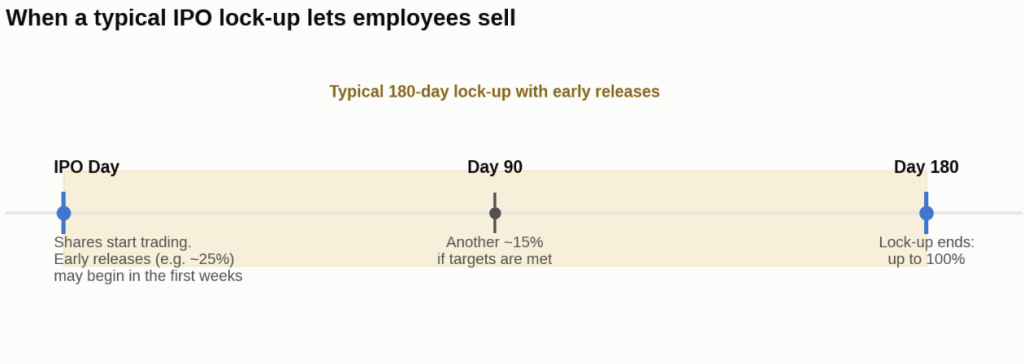
Illustrative. A typical IPO lock-up with early releases; Anthropic’s actual terms may differ.
These are the typical lock-ups, but details vary. Anthropic hasn’t laid out its own terms publicly yet, so treat these as the usual playbook rather than a promise, and ask your stock admin team for your actual dates.
Even after the lock-up ends, a couple of other things must be true before you can sell. First, make sure the equity is actually yours. An option you haven’t exercised isn’t stock yet, and RSUs that haven’t vested aren’t yours yet, so you can’t count on a sale until your shares are vested and, for options, exercised.
Second, remember you’ll be a public-company employee, which comes with its own trading rules even after the lock-up lifts.
Trading windows. Most public companies only let employees trade during open windows, usually a few weeks after earnings. Outside those windows, you can’t trade.
Blackout periods. Around earnings or big announcements, trading shuts off completely, so even vested, unlocked shares may have to wait for the next window.
10b5-1 plans. These are typically for executives or if you have access to sensitive information, but as stated above, Anthropic is considering requiring these for all employees. You schedule your trades in advance, and they run automatically, which keeps you clear of blackout periods and insider-trading rules.3
There’s a Way to Save on Taxes Before the IPO, Too
There’s also a tax move worth looking at before the IPO. One I use with clients is exercising their stock options early, if they’re confident the price will jump afterward. Exercising early can start your long-term capital gains clock sooner and lock in a lower cost basis, which can mean a much smaller tax bill when you finally sell. It depends on your situation, so walk through it with your planner. I get into the tax side in how to minimize taxes on your Anthropic ISOs, NSOs, and RSUs.
What I’d Get Ready Before Your Window Opens
The waiting period isn’t wasted time. It’s when I get clients ready, so when your window opens, you can act on a plan instead of scrambling. Before you can sell, I’d want you to:
- Know exactly what you hold: how many shares, what type (ISOs, NSOs, RSUs), what’s vested, and your cost basis.
- Get your actual lock-up and early-release dates from Anthropic or your stock admin team.
- If all employees end up being required to have a 10b5-1 plan, submit your plan before the IPO or as early as you can, since there’s usually a waiting period before your trades can begin.
- Decide ahead of time how much to sell and how much to keep, so one stock isn’t carrying your whole net worth. I walk through that in how much Anthropic equity to sell after your IPO.
- Map out the tax hit, and whether spreading sales across years or diversifying without a big tax bill makes sense for you.
It depends on your lock-up. A traditional IPO usually locks you up for 180 days, though Anthropic is considering allowing employees to sell on IPO day along with a lock-up longer than 180 days. Check your own final equity terms for your exact details.
2. How much will Anthropic employees make after the IPO?
No one can tell you that in advance, and I’d be wary of anyone who claims they can. It depends on how many shares you hold, how many are vested, your cost basis, and the price when you sell, which can move a lot. Plan around your own numbers, not a headline.
3. Will Anthropic employees have a 180-day lock-up period?
Anthropic hasn’t confirmed its lock-up publicly. 180 days is typical for a traditional IPO, so it’s a reasonable default to plan around, but your actual terms could be different. Anthropic is considering allowing employees to sell on IPO day along with a lock-up longer than 180 days.Your final equity paperwork is the source of truth.
Maybe. Anthropic is considering allowing employees to sell on IPO day along with a lock-up longer than 180 days. Some IPOs include early releases that let you sell a set percentage of your vested shares at specific points, sometimes tied to the stock hitting specific targets. Whether you get that, and how much, depends on the company’s terms.
Usually, but not always the same minute. Once the lock-up lifts, you’ve still got public-company trading rules, so you may need to wait for an open window or sell through a 10b5-1 plan.
6. Do the lock-up for my Anthropic ISOs, NSOs, and RSUs expire at the same time?
Not always. They follow the same lock-up once they’re shares you own, but getting there is different for each: RSUs have to vest, and options (ISOs and NSOs) have to be exercised to turn them into shares first. Where each stands changes your timeline and taxes.
How I Help Anthropic Employees Get Ready to Sell
By the time your lock-up expires, I want you ready to move, not scrambling to figure out what you own and what it’ll cost you.
What I do is map it all out ahead of time: what you hold, when each piece frees up, what selling does to your taxes, and how much to sell versus keep. Then you’ve got a plan to run the day your window opens. If you’ve got Anthropic equity and want a plan before the IPO, schedule a free consultation with me.
Resources:
- Yahoo Finance: What Anthropic’s IPO Means for Wall Street
- U.S. Securities and Exchange Commission, Investor.gov: Lock-Up Agreements
- U.S. Securities and Exchange Commission, Rule 10b5-1 Trading Plans
- Anthropic mulls mandatory employee stock trading plans after IPO, The Information reports

After almost 20 years working in tech for companies including eBay, Yahoo!, Intuit, and startups, I made a career change into the financial world as a fee-only financial planner more than a decade ago. I earned my CFP®, spent a few years at a boutique fee-only firm in San Jose, worked 2 1/2 years at a leading wealth management firm in San Francisco, and then left to build the firm I wish had existed when I was working as a tech professional.
My mission is to help other Silicon Valley tech professionals make the most of their stock options and RSUs to help them reach their financial goals.
